Token supply ledger
Track minted, circulating, contract-held and burned MONSTA separately. A burn inside one cycle must also be read alongside any relaunch rules.
0x8a5d…18b2f
Separate accounting identities from marketing language and understand how burns, liquidity, reserves and proxy controls interact.

MONSTA’s economic model combined several quantities that are often collapsed into the word tokenomics: circulating supply, pool reserves, burned balances, protocol-held assets, eligible snapshot supply and potential relaunch minting. Each number answers a different question.
This hub treats the system as a set of stocks and flows. It shows where units moved, which actions changed supply, why a vault balance was not automatically redeemable, and how shallow liquidity could separate a displayed valuation from an executable result.
Track minted, circulating, contract-held and burned MONSTA separately. A burn inside one cycle must also be read alongside any relaunch rules.
Pool reserves determine executable trades and price impact. Market capitalization does not reveal how much value can leave through the available liquidity.
CAKE or another vault asset can be observed on-chain, but control and claim rules decide whether a holder can realize a proportional share.
Proxy administrators, upgrade events and external contracts can change assumptions without changing the familiar public token address.
Protocol Mechanics covers vaults, cycles and contract logic, Rewards & Culture covers crumbs, staking, nfts and games, and BNB Chain Safety covers verification, wallets and risk. Follow these adjacent hubs when a question crosses contract behavior, accounting, incentives or wallet risk.
Each guide answers one practical question, then points to the evidence and adjacent concepts needed to understand the wider system.

The legacy five-percent split, processing path and hidden assumptions behind tax-token economics.
Open token economics guide
How burns, minimum supply, cycle completion and reminting fit together.
Open token economics guide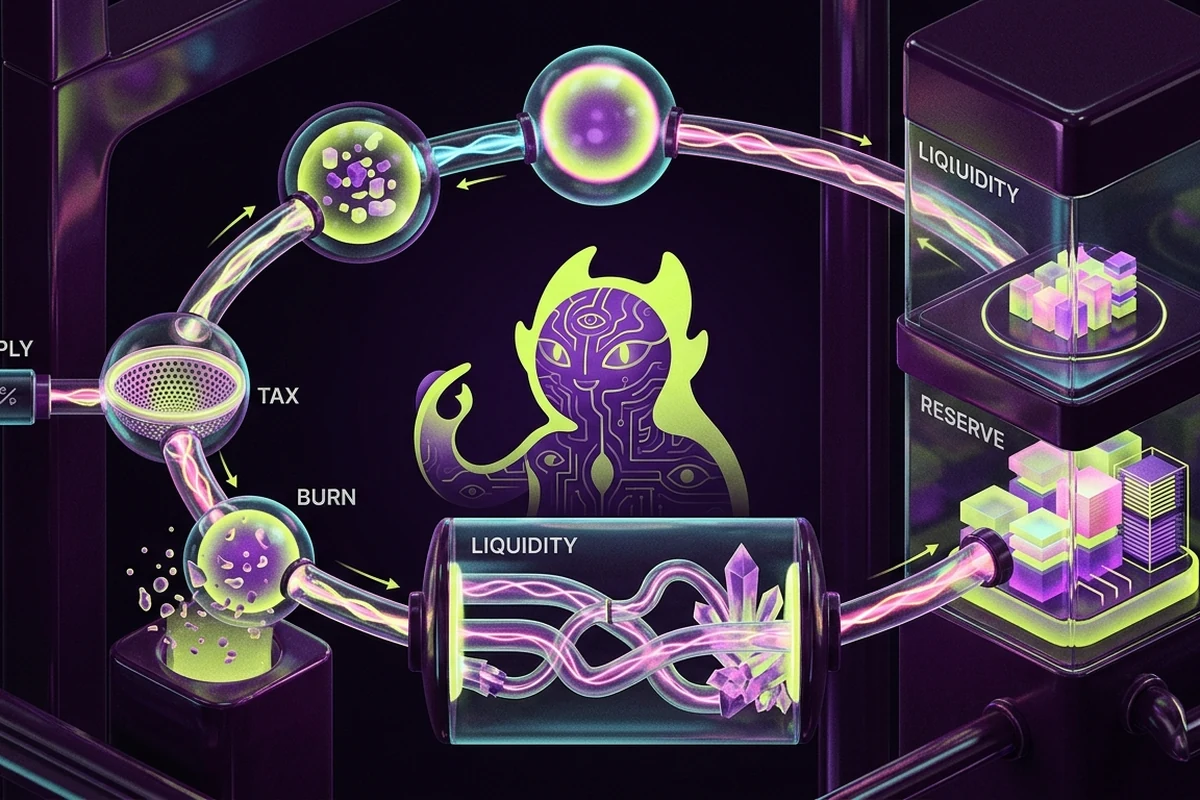
Initial supply, transaction tax, burns, reserves, liquidity and cycle accounting in one model.
Open token economics guide
How pool depth, transfer tax and route selection affect executable prices.
Open token economics guide
Three numbers that sound comparable but answer different questions.
Open token economics guide
Two related tokens with entirely different roles, contracts and risk models.
Open token economics guideShort answers for readers deciding which evidence or guide they need next.
The original design described a five-percent total tax split between burn and vault paths; exact behavior depends on exclusions, transaction type and implementation version.
No. Price also depends on demand, liquidity, claim expectations, market access and confidence in the contracts.
Only as a rough observation. A claim estimate needs the eligible snapshot supply, allocation percentage, window, taxes and execution costs.
These takeaways connect token economics to its evidence model and the neighboring Cake Monster research sections a reader may need next.
supply, liquidity and market structure
Token supply ledger
Protocol Mechanics, Rewards & Culture, BNB Chain Safety